
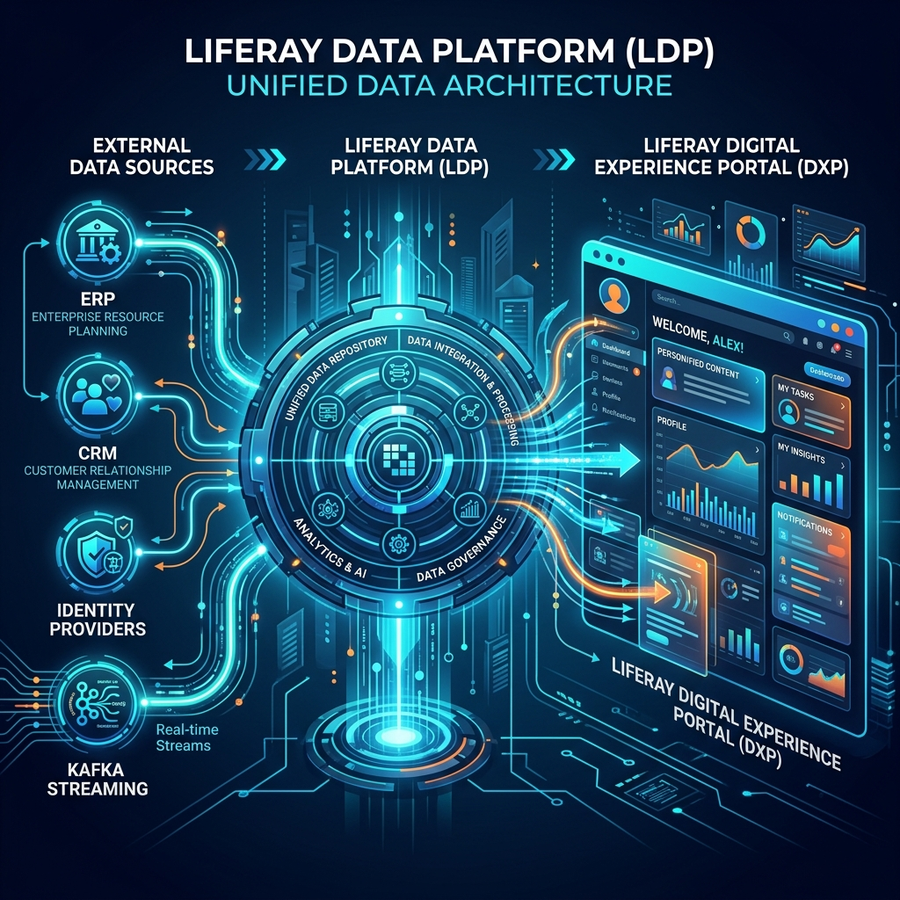
Fig 1. Liferay Data Platform (LDP) acts as the unified data substrate powering real-time personalization across Liferay DXP.
Modern enterprise portals are rarely standalone websites; they are orchestration layers connecting ERPs, CRMs, legacy databases, commerce engines, and customer support desks.
Yet, for solution architects and lead developers, an age-old architectural challenge persists: data gravity and fragmentation. User identity lives in an Identity Provider (IdP) or LDAP directory; purchase history sits in an ERP; behavioral telemetry streams into third-party analytics tools; and support status resides in CRM records.
When architects try to deliver real-time, context-aware experiences on Liferay DXP using disjointed integration pipes, they end up with fragile point-to-point REST calls, bloated session states, and severe latency bottlenecks.
This is where the Liferay Data Platform (LDP) paradigm reshapes the conversation. By treating data ingestion, modeling, identity unification, and downstream activation as first-class architectural concerns, LDP bridges backend enterprise records with front-end digital experiences.
1. What is LDP within the Liferay Ecosystem?
At its core, LDP (Liferay Data Platform) functions as the data aggregation, harmonization, and identity resolution layer for Liferay DXP. Rather than forcing Liferay’s core portal engine (and transactional database) to act as a pseudo-data warehouse, LDP decouples analytical/profile workloads from operational portal runtimes.
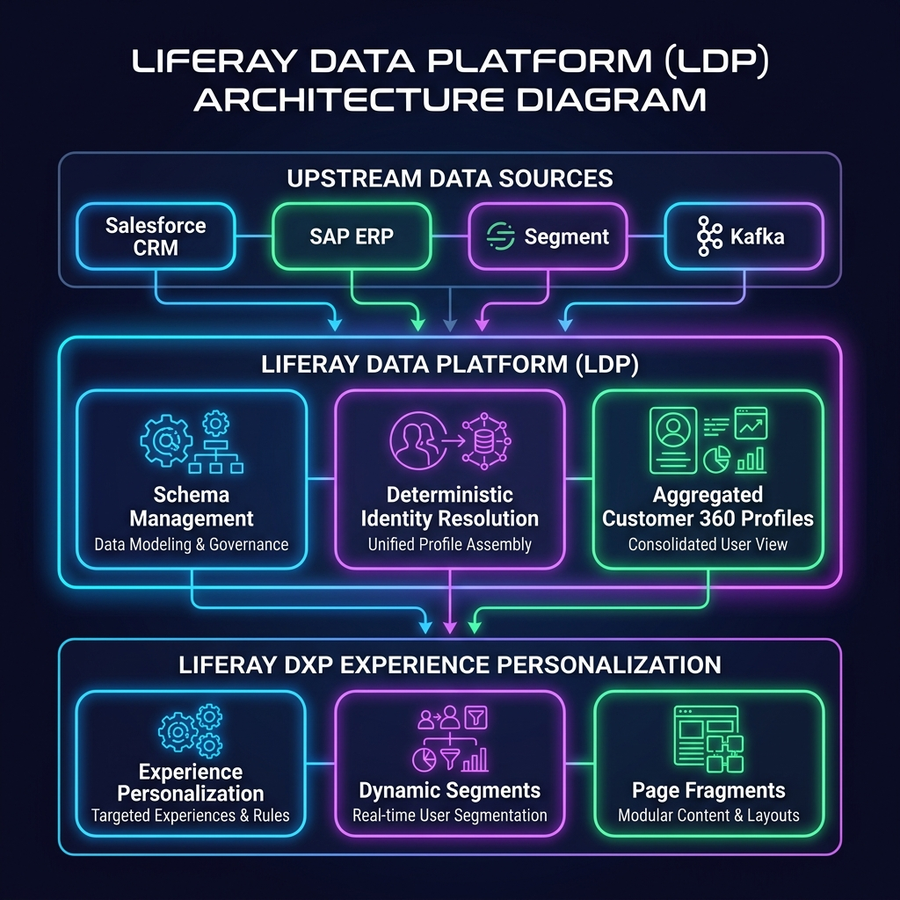
Fig 2. High-level architecture: Upstream Sources -> Liferay Data Platform (LDP) -> Liferay DXP Experience Delivery.
+--------------------------------------------------------------------+
|                         Upstream Sources                           |
|      (Salesforce CRM, SAP ERP, Segment/Kafka, Liferay Forms)       |
+---------------------------------+----------------------------------+
                                  | Ingestion APIs / Webhooks
                                  v
+--------------------------------------------------------------------+
|                    Liferay Data Platform (LDP)                     |
|  - Schema Management & Entity Mapping                              |
|  - Deterministic Identity Resolution (Email / Custom ID / UUID)    |
|  - Aggregated Customer 360 Profiles & Calculated Attributes        |
+---------------------------------+----------------------------------+
                                  | Sync / Real-Time Segment Query
                                  v
+--------------------------------------------------------------------+
|                         Liferay DXP                                |
|  - Experience Personalization & Segments                           |
|  - Dynamic Content Sets & Asset Publishers                         |
|  - Custom Client Extensions & Headless Delivery                    |
+--------------------------------------------------------------------+
The Relationship: DXP vs. LDP vs. Analytics Cloud / CDP
To understand LDP’s architectural placement, it helps to delineate the boundaries:
- Liferay DXP: The delivery and transactional tier. It manages sites, content assets, role-based permissions, headless APIs, workflows, and UI rendering (via Page Fragments and Client Extensions).
- Analytics Cloud (AC) / CDP Layer: Provides the analytical interfaces, out-of-the-box attribution dashboards, funnel analysis, and ML-driven scoring models.
- Liferay Data Platform (LDP): The underlying data substrate. It is responsible for ingest pipelines, deterministic schema management, data synchronization, and serving unified profile data back to DXP for real-time personalization.
2. Core Capabilities & Architecture
A. Scalable Ingestion Pipelines
LDP supports continuous ingestion across multiple channels:
- Batch Ingestion: Bulk imports for legacy databases, daily CSV/SFTP drops, or initial CRM synchronizations.
- Streaming & Event-Driven Ingestion: Real-time event ingestion via webhooks, RESTful endpoints, and messaging brokers (e.g., Apache Kafka).
- Native DXP Telemetry: Automatic tracking of portal events (page views, document downloads, form completions, searches) streamed asynchronously without degrading page response times.
B. Deterministic Identity Resolution
A common issue in distributed platforms is identity fragmentation: an anonymous visitor browses documentation, later submits an inquiry with a business email, and eventually signs into the portal via SAML/OAuth.
LDP employs deterministic matching rules based on configurable identity graphs:
- Primary Identifiers: Master Account IDs, federated UUIDs, verified email addresses.
- Secondary Identifiers: Session tokens, CRM lead IDs, device cookies.
- Merge Logic: When a user transitions from unauthenticated to authenticated, LDP binds their historical behavioral events to the master profile.
C. Flexible Data Modeling & Custom Schemas
Rather than locking architects into fixed user tables, LDP allows custom entity definitions. You can create models for Accounts, Orders, Asset Entitlements, or Support Tickets, mapping both standard and custom attributes with strict type definitions.
D. Real-Time Synchronization & Segment Activation
Data in a silo is useless without activation. LDP synchronizes aggregated segments and computed attributes back to DXP via low-latency caches. This allows DXP’s segment engine to evaluate rules (e.g., Account Tier == "Enterprise" AND Open High-Severity Tickets > 0) instantly upon request evaluation.
3. End-to-End Walkthrough: Ingestion to Dynamic Personalization
Let’s trace a realistic enterprise scenario: A B2B customer with an open critical ticket visits the self-service portal.
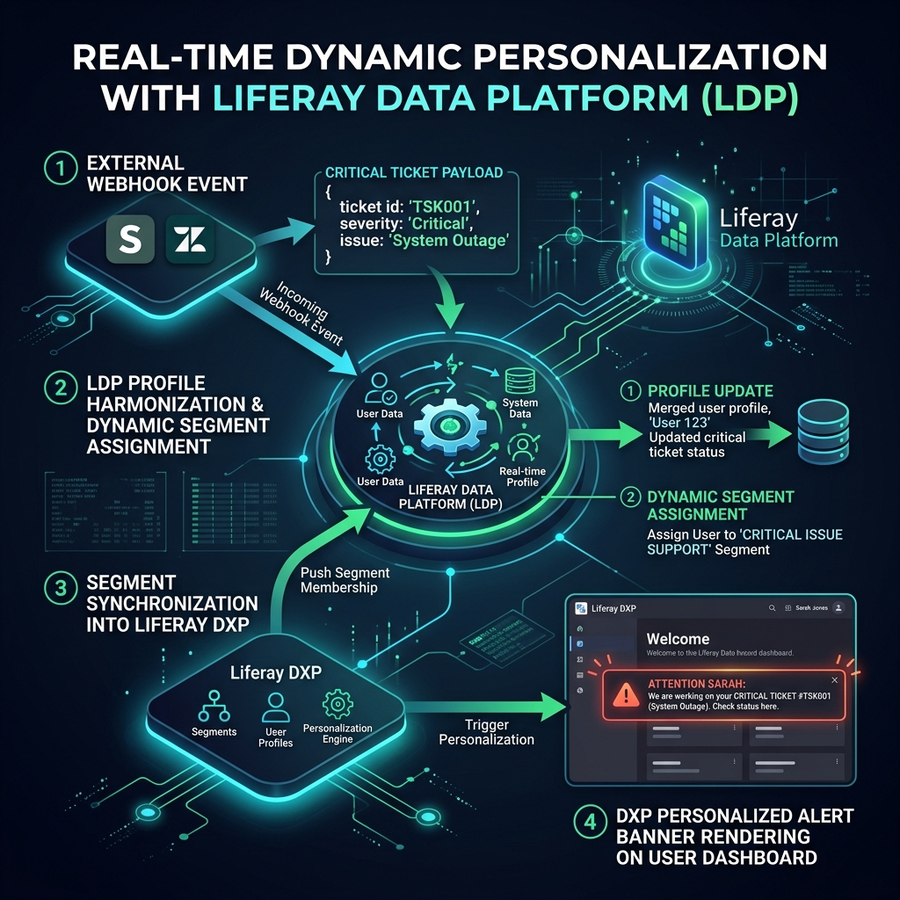
Fig 3. Workflow sequence: ServiceNow ticket webhook -> LDP profile harmonization & segment assignment -> DXP segment sync -> Dynamic personalized page fragment.
Step 1: Ingesting External Data via Webhook/REST
When a ticket is flagged as P1 in ServiceNow or Zendesk, an external webhook pushes an event to LDP’s ingestion API:
{
  "eventType": "ticket_status_updated",
  "timestamp": "2026-09-10T13:45:00Z",
  "identity": {
    "email": "sarah.connor@cyberdyne-systems.com"
  },
  "attributes": {
    "accountId": "ACC-90210",
    "activeCriticalTickets": 1,
    "lastTicketSubject": "Cluster Synchronization Delay",
    "tier": "Tier-1 Enterprise"
  }
}
Step 2: Harmonization & Profile Enrichment
LDP intercepts the payload:
- Maps email to Sarah’s unified profile ID in the identity graph.
- Updates Sarah’s computed attributes (
activeCriticalTickets = 1). - Re-evaluates audience rules and places Sarah into the "VIP Customers in Escalation" dynamic segment.
Step 3: Segment Synchronization into Liferay DXP
LDP broadcasts the segment membership update back to Liferay DXP. In DXP’s Segments & Experiences management:
The user sarah.connor@cyberdyne-systems.com is automatically associated with the synced segment tag: VIP - Escalated Support.
Step 4: Activating Content via DXP Page Fragments & Headless APIs
When Sarah hits the portal homepage (/web/client-portal/dashboard), DXP’s layout engine renders a tailored Experience:
<!-- Personalized DXP Page Fragment: Escalation Banner -->
<div class="alert alert-warning d-flex align-items-center justify-content-between p-4 mb-4 rounded shadow-sm">
  <div class="d-flex align-items-center">
    <svg class="lexicon-icon lexicon-icon-warning-full mr-3 text-danger" focusable="false" role="presentation">
      <use href="/o/admin-theme/images/clay/icons.svg#warning-full" />
    </svg>
    <div>
      <h5 class="mb-1 font-weight-bold">Active Priority Incident: Cluster Synchronization Delay</h5>
      <p class="mb-0 text-secondary small">Our senior site reliability engineering team is actively investigating your ticket (#INC-4412).</p>
    </div>
  </div>
  <a href="/group/customer-portal/support/tickets/INC-4412" class="btn btn-danger btn-sm font-weight-bold">
    Track Live Status
  </a>
</div>
The portal shifts from a static brochure to an operational dashboard without requiring custom batch jobs or complex backend database joins on the portal server.
4. Architectural Best Practices
1. Optimize Ingestion Pipelines (Batch vs. Stream)
- Avoid routing high-volume event streams through synchronous DXP Service Builder layers.
- Decouple your streaming feeds using message brokers or direct LDP ingest endpoints, letting DXP consume only finalized segment memberships and aggregated states.
2. Practice Rigid Data Governance & Privacy Compliance
- PII Segregation: Never store sensitive plaintext PII (passwords, raw payment credentials, SSNs) inside the behavioral data layer. Store only tokenized identifiers.
- Consent Management: Tie LDP ingestion to cookie banners and user consent frameworks (GDPR, CCPA). Ensure that opt-out events trigger automated cascade deletion or anonymization routines across the profile graph.
3. Handle Edge-Cache Invalidation Intelligently
- Personalization can break CDN caching if not designed properly.
- Use Client Extensions or localized fragment-level rendering for personalized components, allowing the surrounding page layout and assets to remain globally cached via CDN edge nodes.
5. How Pyronite Can Help: Exploring & Integrating LDP in Your Enterprise
Transitioning from fragmented, point-to-point portal integrations to a unified data architecture requires deep expertise across enterprise data pipelines, Liferay DXP internals, and real-time activation layers. At Pyronite, we specialize in modernizing complex Liferay DXP ecosystems with high-performance data architectures:
- Custom LDP Ingestion & Streaming Pipelines: We architect high-throughput, low-latency ingestion feeds from SAP, Salesforce, Kafka, and custom microservices directly into LDP without overloading portal transactional databases.
- Identity Graph & Schema Design: Our engineers design deterministic identity resolution rules and custom entity schemas tailored to your domain (Accounts, Entitlements, Order Statuses, Support Escalations).
- Real-Time DXP Personalization & Client Extensions: We build dynamic Page Fragments, Custom Client Extensions, and low-latency cached segment queries that activate LDP insights on page load.
- CDN Edge-Cache & Performance Optimization: We implement intelligent caching strategies so personalized experience components don't degrade global CDN caching or slow down response times.
- Data Governance & Compliance Audits: We enforce strict PII segregation, tokenized identities, and GDPR/CCPA consent-driven cleanup routines across all data pipelines.
Our Proven Integration Framework:
- Phase 1: Architecture & Schema Modeling — Audit existing data silos, define master identity keys, and establish custom entity schemas.
- Phase 2: Ingestion & Synchronization Setup — Wire batch/streaming webhooks, configure low-latency caches, and sync segment tags to DXP.
- Phase 3: Experience Activation & Security Hardening — Deploy personalized UI fragments, test edge-caching strategies, and enforce role-based least privilege.
Ready to Explore or Integrate LDP? Whether you are planning an architectural migration or looking to activate real-time personalization on Liferay DXP, our lead architects are here to guide your team.
👉 Connect with the Pyronite Engineering Team to schedule an architecture review and prototype your LDP integration.
Final Thoughts
The real value of modernizing your Liferay DXP architecture with LDP isn’t merely collecting more data—it’s shortening the distance between raw enterprise signals and actionable digital experiences.
By decoupling analytics and customer identity management from portal execution, architects can deliver real-time personalization and cohesive journeys at enterprise scale without compromising stability or performance.